Prefab & Modular ADU Construction Raleigh NC
Prefab and modular ADU construction for Raleigh homeowners considering a factory-built approach. We help you understand what prefab and modular actually mean, the site work a factory-built unit still requires, and how to compare prefab with site-built construction for your specific Triangle property.
Factory-built modular and prefabricated accessory dwelling units for Raleigh properties — including the site preparation, foundation, utility connections, delivery access and local permitting that a factory-built unit still requires.
Prefab and Modular ADU Options
Prefab and modular ADUs are accessory dwelling units built partly or wholly in a factory and delivered to the site. The appeal is understandable: a unit built indoors, in controlled conditions, that arrives largely complete. But a factory-built ADU is not a turnkey solution that skips the site — it still requires a foundation, utility connections, delivery access and local permitting.
For Raleigh homeowners, prefab and modular are options worth considering alongside site-built construction, not replacements for it. Whether a factory-built approach makes sense depends on the property — especially whether a large module can physically reach the buildable area — and on whether a standard layout meets the household's needs. We help homeowners evaluate that honestly.
We do not assume prefab is cheaper, faster or easier to permit. Those outcomes depend on the specific product, the site and the jurisdiction. What we do is evaluate prefab and modular against site-built construction for the specific property, so the homeowner chooses with accurate information.
What Does Prefab or Modular Actually Mean?
The terms are used loosely, and that causes confusion. Prefab is a broad category that includes several construction methods; modular is one specific method within it. Understanding the distinction matters because the methods have different implications for site work, permitting and design flexibility.
- Modular construction — complete room-sized modules built in a factory, shipped and assembled on site into a complete dwelling
- Panelized construction — wall and roof panels built in a factory, shipped flat and assembled on site
- Pre-cut or kit construction — pre-cut materials shipped to the site for assembly, with more on-site labor
- Manufactured homes — built to a federal HUD code, distinct from modular built to the local building code
A modular ADU is built to the same building code as a site-built home — the local residential code that applies in Raleigh. A manufactured home is built to a separate federal standard and is regulated differently. This distinction affects what the jurisdiction permits on your lot, so it matters during feasibility.
Modular is not the same as manufactured
A modular ADU is factory-built to the local residential building code and is generally permitted like a site-built ADU. A manufactured home is built to a federal HUD code and is subject to different zoning and permitting rules. The two are not interchangeable, and the distinction affects what your lot allows.
The Site Still Matters
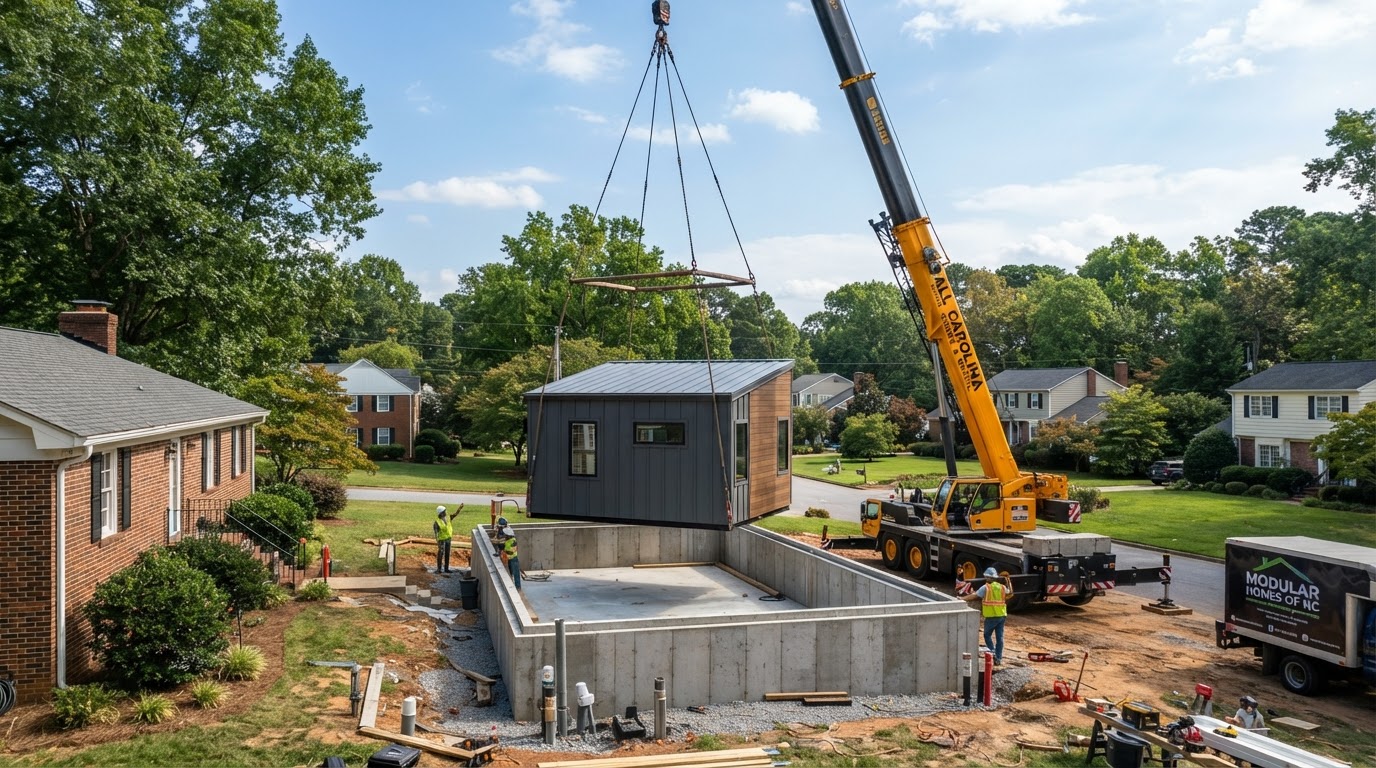
A factory-built ADU does not eliminate site work — it changes it. The module still has to reach the buildable area, sit on a foundation, connect to utilities, drain properly and meet local permitting. In some ways the site requirements are more specific, because the module arrives as a fixed dimension that the site has to accommodate.
- Access — whether a crane and a wide load can reach the buildable area from the street
- Foundation — a code-compliant foundation sized for the module, prepared before delivery
- Utilities — water, sewer and electrical connections ready for the unit to tie into
- Grading and drainage — the site prepared so the unit sits and drains correctly
- Placement — a clear path and set-down area for the module
- Permitting — local building-department approval, including the foundation and utility work
On a Raleigh lot with a narrow side yard, overhead wires, or a long setback from the street, delivery access can be the deciding factor. A modular unit that cannot physically reach the buildable area is not an option for that lot, regardless of its design. We assess access during feasibility.
Want to know if your property qualifies?
Start with a parcel-specific feasibility review of your Raleigh or Triangle address.
Prefab vs Site-Built Considerations
The choice between prefab and site-built is not about which is better in general; it is about which fits the property and the goals. The comparison below outlines the trade-offs at a high level — we do not invent costs or schedules, because those depend on the specific product and site.
| Factor | Prefab / Modular | Site-Built |
|---|---|---|
| Customization | Limited to factory configurations | Full layout flexibility |
| Site conditions | Requires delivery access for large modules | Adapts to any accessible lot |
| Transportation | Crane and wide-load delivery to the site | Materials delivered in standard loads |
| Foundation | Code-compliant foundation prepared before delivery | Foundation built as part of the project |
| Construction method | Factory assembly plus on-site set and finish | Built entirely on site |
| Design flexibility | Constrained by module dimensions | Constrained only by zoning and budget |
Prefab can reduce on-site construction time once the module is delivered, but the design, permitting, foundation and utility work happen before delivery — and that timeline is comparable to site-built. The total project timeline depends on the product lead time plus the site work, not on the on-site assembly alone.
Permit and Property Considerations
A prefab or modular ADU is permitted through the same building department as a site-built unit, and it must meet the same residential building code. The zoning, setback, height and utility requirements that apply to your lot do not change because the unit is factory-built. What changes is the documentation — the manufacturer's plans and the site-specific foundation and utility work both have to be submitted.
- Zoning and setbacks — the same rules apply regardless of construction method
- Foundation design — a site-specific foundation engineered for the module
- Utility connections — water, sewer and electrical work permitted locally
- Building code — modular units must meet the local residential code
- Inspections — foundation, set, utility and final inspections by the local jurisdiction
We do not claim that prefab is easier to permit. The permitting effort is comparable because the site work — foundation, utilities, drainage — is the same. What the factory provides is the building envelope; what the site provides is everything else, and that everything else is what the permit covers.
Choosing the Right ADU Construction Method
The right method depends on the property and the goals, not on a preference for factory-built or site-built construction. A prefab or modular ADU is a good fit when a standard layout works, the site has delivery access, and the homeowner values the factory build environment. A site-built or custom ADU is the better fit when the lot is unusual, the layout needs to be specific, or delivery access is constrained.
We evaluate both paths during feasibility. The decision is not ideological — it is practical, based on what your lot allows and what your household needs. Some properties are well suited to prefab; others are not. We tell you which, and why, before you commit to a direction.
Common Questions About Prefab & Modular ADU Construction
A prefab ADU is an accessory dwelling unit built partly or wholly in a factory and delivered to the site. Prefab is a broad category that includes modular construction (complete room-sized modules), panelized construction (factory-built wall panels) and pre-cut kits. A prefab ADU still requires a foundation, utility connections, delivery access and local permitting on the site.
A modular ADU is factory-built to the local residential building code and is generally permitted like a site-built ADU. A manufactured home is built to a federal HUD code and is subject to different zoning and permitting rules. The two are not interchangeable, and the distinction affects what your lot allows. We clarify which applies during feasibility.
Yes. A prefab or modular ADU is permitted through the same building department as a site-built unit and must meet the same residential building code. The zoning, setback, height and utility requirements that apply to your lot do not change because the unit is factory-built. The site work — foundation, utilities, drainage — is what the permit covers.
Not necessarily. The cost depends on the specific product, the site work required, the foundation and utility connections, and the finishes. A factory-built unit may reduce on-site construction time, but the design, permitting, foundation and utility work happen before delivery and are comparable to site-built. We do not assume prefab is cheaper; we compare total project cost for your specific property.
No. A prefab or modular ADU requires delivery access — a crane and a wide load have to reach the buildable area from the street. On lots with narrow side yards, overhead wires, or long setbacks, delivery access can be the deciding factor. We assess access during feasibility before recommending a prefab approach.
On-site assembly of a delivered module can be faster than site-built framing, but the total project timeline includes design, permitting, foundation and utility work before delivery, plus the product lead time. The total timeline depends on the product and the site, not on the on-site assembly alone. We outline a realistic timeline for your scope during feasibility.
The comparison comes down to customization, site access and design flexibility. Prefab offers a standardized build with less layout flexibility but requires delivery access; a custom site-built ADU offers full layout flexibility and adapts to any accessible lot. We evaluate both against your specific property and goals during feasibility so you choose with accurate information.
Continue exploring Prefab & Modular ADU Construction
Considering a Prefab or Modular ADU?
Tell us about your lot. We evaluate whether prefab or modular is realistic for your property — including access, foundation and utility work — and compare it with site-built options.