
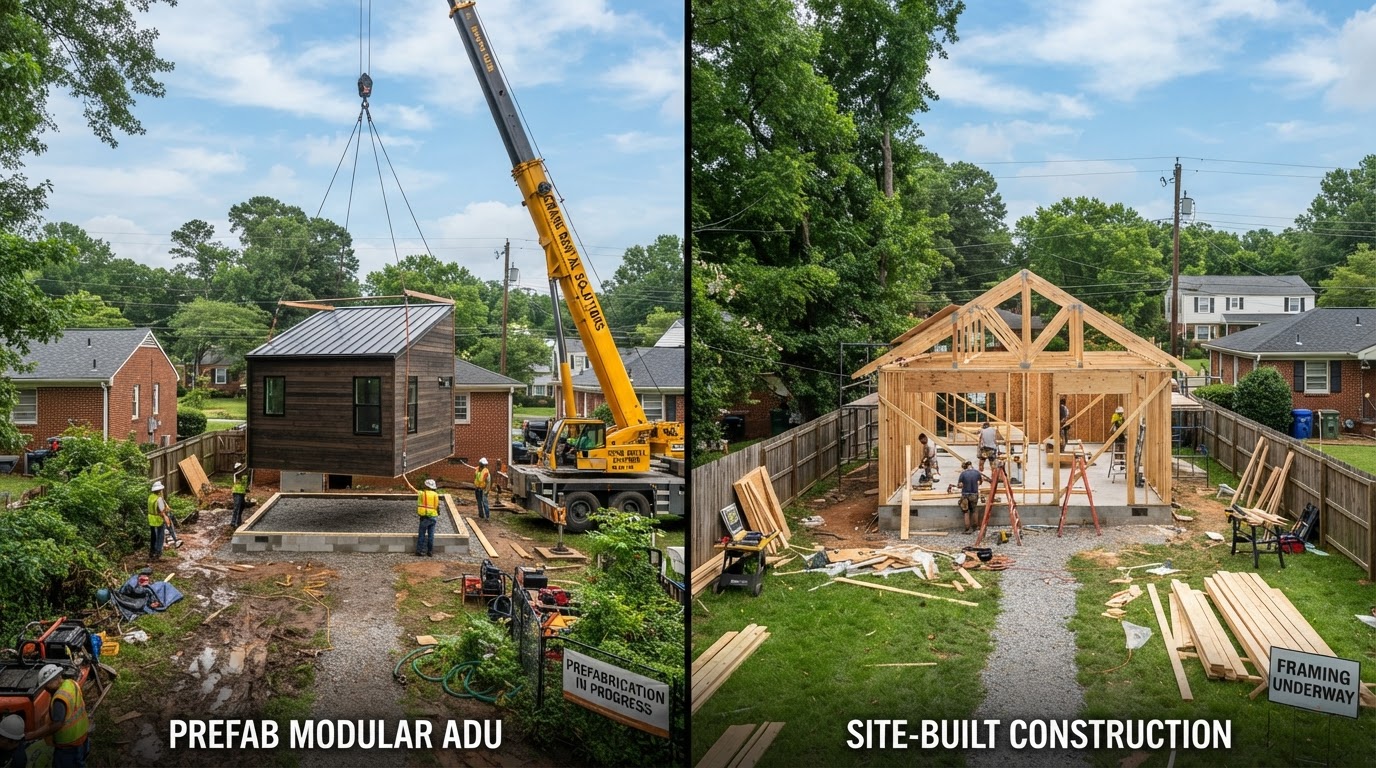
Prefab vs Site-Built ADU
Neither construction approach is automatically better. Prefab or modular ADUs can offer a more standardized production process, while site-built ADUs can provide greater property-specific and architectural flexibility. But site access, permitting, foundation work, utilities and customization still matter for both — and a prefab ADU doesn't eliminate site work. This comparison helps you weigh the two by your actual property and goals, not by a default assumption that prefab is cheaper or faster.
Comparison of prefab and site-built ADUs in Raleigh: construction method, customization, site access, delivery, foundation, utilities, permits, schedule, cost and how to choose by property and goals.
Last reviewed: 2026-11-21
Prefab vs Site-Built ADU at a Glance
Prefab ADUs produce significant portions off-site in a controlled environment; site-built ADUs are constructed primarily at the property. The trade-offs are customization, delivery access, schedule predictability and how much site work remains either way.
| Factor | Prefab / Modular ADU | Site-Built ADU |
|---|---|---|
| Construction | Significant off-site production possible | Primarily constructed on site |
| Customization | Varies by system | Often highly flexible |
| Delivery access | Important — may need crane or wide access | Less dependent on large-module delivery |
| Foundation | Still required | Required |
| Utilities | Still required | Required |
| Site preparation | Still required | Required |
| Permit review | Still applies | Still applies |
| Architecture | Product or system dependent | Highly property-specific |
The key misunderstanding is that prefab eliminates site work. It doesn't. A prefab or modular ADU still needs a foundation, utility connections, site preparation, grading, drainage and permitting — plus delivery access, which can be a significant constraint on a tight lot. What changes is where the structure itself is built.
What Is a Prefab ADU?
'Prefab' is a broad term for ADUs where significant portions — panels, modules or larger sections — are produced off-site in a controlled environment, then assembled at the property.
Prefab spans a range: panelized kits where walls are built off-site and assembled on a site-built foundation; modular units where entire rooms or larger sections are fully finished indoors and lifted into place; and variations in between. We don't treat 'prefab' and 'modular' as identical — they describe different levels of off-site completion, and the distinctions matter for what arrives at the lot and what still needs to happen there.
Potential advantages include a more standardized production process, factory-controlled quality and potentially shorter on-site construction time. The trade-offs are customization limits that vary by system, delivery access requirements and the fact that foundation, utilities and site work still need to happen at the property.
What Is a Site-Built ADU?
A site-built ADU is constructed primarily at the property using conventional construction — foundation, framing, systems and finishes all built on the lot.
Site-built construction offers the greatest design flexibility: the floor plan, ceiling height, window placement, exterior style and interior finishes can all be tailored to the property and the household. It doesn't depend on delivery access for large modules, which matters on tight lots or lots with difficult rear access. The trade-off is that the construction sequence happens at the property, which can mean a longer on-site build and more weather exposure.
Does Prefab Eliminate Site Work?
No. This is the most common misconception — and it's where prefab budgets quietly grow.
- Site preparation — grading, clearing, access for delivery
- Foundation — a prefab unit still needs an approved foundation system
- Utilities — water, sewer, electrical and HVAC connections to the unit
- Grading and drainage — stormwater management around the new structure
- Permits — plan review, permitting and inspections still apply
- Delivery access — crane, wide access, road closures may be needed
A prefab ADU may shorten the on-site construction phase for the structure itself, but the site work, foundation, utilities, permitting and delivery logistics are all still real scope — and real cost. On a lot with difficult access, the delivery and crane requirements can add significant cost that a site-built approach might avoid.
Which Offers More Customization?
Generally, site-built construction allows greater customization, while prefab systems vary significantly by manufacturer and product.
A site-built ADU can be designed around the lot, the household and the existing home — floor plan, ceiling height, window arrangement, exterior style and interior finishes are all flexible. Prefab systems offer varying levels of customization: some allow significant finish and layout choices within a standardized envelope; others are essentially fixed products. The right question is what level of customization the household needs and whether a given prefab system provides it.
We don't make absolute claims. For a household that wants a particular architectural style or a layout shaped to an unusual lot, site-built may be the better fit. For a household that values a standardized process and is comfortable with a product's offerings, prefab may work well.
Want to know if your property qualifies?
Start with a parcel-specific feasibility review of your Raleigh or Triangle address.
Which Is Faster?
Prefab manufacturing may change the construction sequence, but total project time depends on many steps — and we don't promise faster completion.
- Design — custom or product selection
- Permits — plan review and approval
- Manufacturing — factory production time for prefab
- Site work — excavation, grading, foundation
- Utility work — water, sewer, electrical connections
- Delivery — scheduling, transport, crane
- Installation and on-site finishing
A prefab ADU may compress the on-site structure phase, but the total timeline still includes design, permitting, site work, utilities and delivery coordination — some of which can run concurrently, some of which can't. A site-built ADU spreads construction over more time at the property but may avoid the manufacturing lead time. Which is faster depends on the specific project, and we won't guarantee a timeline advantage for either approach.
Which Costs Less?
Neither approach is universally less expensive. Cost depends on the base unit, transportation, site work, utilities, customization and finishes.
- Base unit price — varies by prefab system or site-built scope
- Transportation — delivery, escort, road closures for prefab
- Crane and access — significant on tight lots for prefab modules
- Foundation — required for both
- Site work and utilities — required for both
- Customization — more for site-built, limited for some prefab systems
- Finish level — affects both
A prefab base unit may look less expensive until delivery, crane, foundation and site work are added. A site-built ADU may carry more construction labor but avoid transportation and access costs. The honest answer is that the cost comparison is property-specific — and a feasibility review that accounts for the lot, the access and the design goals is what produces a real budget either way.
Which Option Fits Your Property?
The right choice follows the lot, the access, the design goals and the household's priorities — not a default.
A prefab or modular ADU may make more sense when:
The household values a standardized production process; delivery access is feasible; customization needs fit a product's offerings; and the appeal of factory-controlled construction matters more than a fully custom design.
A site-built ADU may make more sense when:
The lot or access makes module delivery difficult; a custom layout, ceiling height or architectural style is important; the design needs to respond to an unusual lot; or the household wants maximum control over finishes and details.
There's also a middle path: Raleigh Fast Track or pre-reviewed ADU plan options can offer some of the standardization of a prefab approach within a site-built project. We don't claim one path is always best — the property and the goals decide.
Common Questions About Raleigh Prefab vs Site-Built ADU Guide
Not universally. A prefab base unit may look less expensive, but delivery, crane access, foundation, site work and utilities are still required. A site-built ADU may carry more construction labor but avoid transportation and access costs. Cost is property-specific — neither is automatically cheaper.
Prefab may compress the on-site structure phase, but the total timeline still includes design, permitting, manufacturing, site work, utilities and delivery. We don't promise a timeline advantage for either approach — which is faster depends on the specific project.
Yes. A prefab or modular ADU still requires plan review, permitting and inspections — the construction method doesn't bypass the regulatory process. Current Raleigh requirements apply regardless of whether the structure is built off-site or on-site.
It varies by system. Some prefab products allow significant finish and layout choices within a standardized envelope; others are essentially fixed. Site-built construction generally offers greater customization. The right question is what level of customization the household needs and whether a given system provides it.
No. A prefab ADU still needs site preparation, a foundation, utility connections, grading, drainage and permitting. Delivery access — including crane and wide access — can add significant cost on a tight lot. What changes is where the structure is built, not the site work.
Not exactly. 'Prefab' is a broad term; 'modular' describes a specific level of off-site completion where entire rooms or larger sections are fully finished indoors. Prefab can range from panelized kits to full modular units. The distinctions matter for what arrives at the lot and what still needs to happen there.
It depends on access. A tight lot or difficult rear access can make module delivery and crane placement expensive or impossible, favoring site-built. But some prefab systems with smaller components may still work. The lot's access conditions are a key factor in the decision.
Evaluate the lot and access, the design goals, the customization needs and the household's priorities. A prefab or modular ADU suits standardized production and feasible delivery; a site-built ADU suits custom design and difficult access. A property-specific feasibility review is the most reliable way to decide.
Continue exploring Prefab vs Site-Built ADU
Prefab or Site-Built?
Tell us about the lot, the access and the design goals. We help you evaluate whether a prefab or site-built approach fits the property — and what each path realistically involves.