
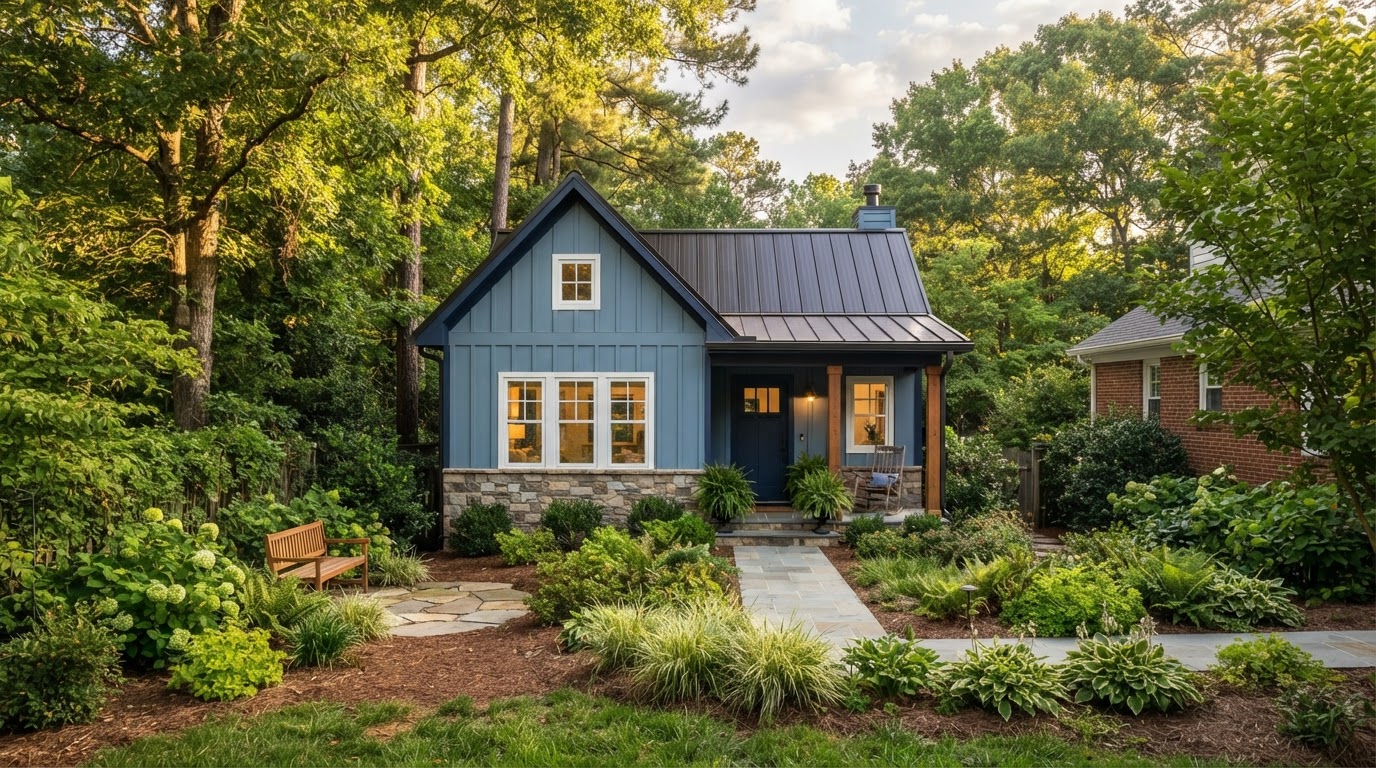
ADU & In-Law Suite Builders Butner NC
Butner homeowners add independent living space through detached ADUs, garage apartments, garage conversions and in-law suites. Because the Town of Butner sets its own zoning and accessory structure rules — and because some Butner mailing addresses fall outside town limits under Granville County jurisdiction — every project starts with a parcel-specific review against current Butner or county requirements.
Detached ADUs, garage apartments, garage conversions and in-law suites for Butner homeowners, with Town of Butner and Granville County jurisdiction review and feasibility planning.
Last reviewed: 2026-11-21
ADU & In-Law Suite Construction in Butner
Butner homeowners build accessory living space for aging parents, adult children, guests and long-term household flexibility. The project types that fit Butner properties range from detached backyard ADUs and guest cottages to garage apartments, garage conversions and in-law suites — each shaped by the lot, existing structures and current Town of Butner or Granville County rules.
Butner is in Granville County, and the Town of Butner governs its own zoning and accessory structure standards where a property is within town jurisdiction. Some Butner mailing addresses fall outside town limits and may be governed by Granville County instead, depending on the actual parcel. Confirming the actual governing authority through official property records is part of any real feasibility review — we don't apply Raleigh, Wake County or Creedmoor standards to Butner properties.
Local ADU Planning Note
ADU and in-law suite feasibility depends on the property's jurisdiction, zoning, lot configuration, utilities, existing structures and proposed use. Butner requirements are not Raleigh or Wake County requirements — confirm current Town of Butner (or Granville County) rules for your parcel before final design.
Detached ADUs & Family Housing Options in Butner
Butner's mix of established residential areas, newer housing and varied lot configurations means some parcels have genuine room for a freestanding backyard ADU. A detached ADU is the most independent living option and is often chosen for parent ADUs, guest house ADUs and downsizing.
We don't imply every Butner property is large. Lot sizes vary, and the buildable area is what's left after setbacks, easements, existing improvements and lot-coverage limits are accounted for under Town of Butner or Granville County rules. One-bedroom and two-bedroom detached ADUs each carry different utility and septic implications. On properties outside municipal utility service, detached ADUs may involve well water, septic and longer utility runs — which makes utility and septic feasibility a defining early question.
Adult-child housing and parent ADUs are common goals where room allows. Where a detached ADU doesn't fit the lot, garage and outbuilding conversions often become the more realistic path.
Garage Conversions & Garage Apartments in Butner
Garage-based projects are a practical entry point on many Butner properties, where garage-oriented homes and detached garages appear across housing eras. A garage conversion reuses existing enclosed footprint; a garage apartment adds independent living space above or beside a garage; a detached garage conversion reuses an existing outbuilding's footprint.
The existing structure is always the deciding factor. An apartment above an existing garage depends on whether the foundation and framing can carry a second story — frequently they can't, and a new garage built with an apartment becomes the realistic path. We evaluate the slab, foundation, framing, roof structure and moisture history before recommending conversion. A garage in-law suite can work when the garage is well-located and structurally sound.
On Butner's varied lots, garage projects can preserve yard space that a separate detached ADU would consume — but only if the existing structure can support residential conversion. Where the existing structure is unsuitable, a garage replacement with an apartment or ADU is often the more realistic path.
Butner Property & Housing Context
Butner's residential character blends established residential areas, newer housing and varied lot configurations, sitting in Granville County. That range is materially different from denser Wake County suburbs and directly shapes which ADU project types are realistic on a given parcel.
Established residential areas tend to have moderate lots with a mix of older and newer construction. Newer housing may carry HOA covenants that restrict accessory structures independently of town or county zoning. Town-edge properties may have larger parcels, garage-oriented homes, existing accessory structures, and well or septic service rather than municipal utilities.
We don't generalize about which Butner neighborhoods allow ADUs or which authority governs a given mailing address. We verify the actual property record, zoning designation, utility jurisdiction and any private covenants for the specific parcel before recommending a project type.
Private covenants are separate from zoning
Town of Butner or Granville County zoning approval does not override HOA or private covenant restrictions. Confirm both municipal and private requirements before final design, especially in newer covenant-governed communities.
Butner / Granville County ADU Rules & Jurisdiction
Butner ADU and accessory structure requirements are set by the Town of Butner where a property is within town jurisdiction, and by Granville County where a parcel falls outside town limits. Zoning authority, accessory dwelling treatment, permit authority and utility jurisdiction all depend on the actual property.
We don't apply Raleigh, Wake County or Creedmoor standards to Butner. The Town of Butner may define accessory dwellings differently, permit them in different districts, and set different dimensional standards. Where a Butner mailing address falls outside town jurisdiction, Granville County rules apply and must be confirmed separately. We don't invent Granville County requirements. Where a specific rule can't be verified at review time, we say plainly that it requires property-specific confirmation.
| Topic | What to Verify for Butner / Granville County |
|---|---|
| Jurisdiction | Town of Butner vs Granville County for the specific parcel |
| ADU classification | How the Town of Butner defines an ADU or accessory apartment |
| Permitted districts | Which Butner zoning districts allow accessory dwellings |
| Setbacks | Current Butner or county setback standards |
| Height & size | Any limits on ADU height, footprint or floor area |
| Utilities | Public water/sewer vs well/septic for the specific parcel |
| County context | Granville County rules where the parcel is outside town limits |
| Permit process | Current Butner or county review workflow |
Want to know if your property qualifies?
Start with a parcel-specific feasibility review of your Raleigh or Triangle address.
In-Law Suites & Aging-Parent Living in Butner
Butner families building for aging parents or multigenerational living often choose an in-law suite. The term describes the household use, not a single project type — the same goal can be met by a first-floor suite, an attached addition, a detached parent ADU, a garage in-law suite or an accessible layout.
For aging parents, design usually centers on proximity and accessibility. An attached first-floor suite with a private entrance keeps parents close and simplifies caregiver support. On larger edge parcels, a detached parent ADU can offer genuine independence — but it adds outdoor exposure and depends on utility and septic feasibility. A garage in-law suite can work when the garage is well-located and structurally sound. On septic properties, bedroom count can affect septic capacity and should be verified early.
We plan accessibility around the household — wider doorways, accessible bathrooms, level entries and future caregiver access — without claiming ADA compliance unless a project is specifically designed and verified to that standard.
Utilities, Septic & Site Feasibility in Butner
Utility and septic review is often decisive on Butner-area properties, where the mix of residential lots and edge parcels means utility service varies parcel-to-parcel. Whether a parcel is on public water and sewer or on well and septic can determine whether an ADU is feasible at all.
Properties outside municipal utility service areas may require additional septic or well-related review. Septic capacity — and whether the existing system can support an additional dwelling or bedroom — can be a decisive feasibility factor and may require separate Granville County environmental health review. We don't invent Granville County septic requirements; we confirm what applies to the specific parcel. Electrical service may need a panel upgrade, and long utility runs on larger parcels add trenching scope. Driveway and site access matter for construction staging.
- Public water/sewer vs well/septic for the specific parcel
- Septic capacity for an additional dwelling or bedroom
- Electrical panel capacity and potential service upgrade
- Long utility runs and trenching scope on edge parcels
- Existing garage or outbuilding condition for conversions
- Driveway and construction access for staging
Choose the ADU Type After Local Review
The right ADU type on a Butner property depends on the lot, existing structures, household goals, utilities, septic and budget — not on a generic recommendation. A feasibility review narrows the options to what actually fits your parcel under current Town of Butner (or Granville County) rules.
We serve Butner homeowners from our Raleigh-based practice. There is no separate Butner office, and we don't claim one. Every Butner project is reviewed against current Town of Butner (or Granville County) requirements for the specific parcel, with jurisdiction confirmed through official property records.
Nearby areas we also serve: Creedmoor, Durham, Hillsborough and Franklinton. Each municipality and county sets its own rules, so a Butner project isn't automatically the same as one in a neighboring Granville County community.
Common Questions About ADU & In-Law Suite Construction in Butner NC
Whether an ADU is allowed on a Butner property depends on current Town of Butner zoning (or Granville County rules if the parcel is outside town limits), the lot, setbacks, utilities, septic and any HOA covenants. Butner is in Granville County, not Wake County. A parcel-specific feasibility review confirms what's permitted.
A garage apartment in Butner is possible when the existing garage can structurally support a second story, or when a new garage is built with an apartment from the start. Whether an existing garage can carry living quarters above requires structural evaluation. A structural evaluation should come before design.
An in-law suite in Butner can take several forms — an attached addition, first-floor suite, garage in-law suite or detached parent ADU — depending on the lot, existing structures, accessibility needs and current Town of Butner or Granville County rules. A feasibility review identifies which project type fits your property and household goals.
Whether a detached ADU is permitted on a Butner property depends on the zoning district, setbacks, lot coverage, utilities, septic and current Town of Butner (or Granville County) rules for the specific parcel. We don't state a universal yes or no — feasibility is confirmed through a parcel-specific review.
ADU feasibility on a septic property near Butner depends on whether the existing septic system has capacity for an additional dwelling or bedroom. Septic capacity may require separate Granville County environmental health review and can be a decisive factor. We don't invent septic requirements — we confirm what applies to the specific parcel.
Butner is in Granville County. The Town of Butner sets its own zoning and accessory structure rules where a property is within town jurisdiction. Some Butner-area mailing addresses may fall outside town limits and be governed by Granville County. Jurisdiction is confirmed through official property records.
Not necessarily. Butner and Creedmoor are both in Granville County but are separate municipalities that may set their own zoning and accessory structure standards. Where a parcel is outside town limits, Granville County rules apply. We confirm the actual governing authority for the specific parcel rather than assuming neighboring towns share identical rules.
Yes. Butner properties in HOA-governed communities may have covenants that restrict accessory structures, exterior changes or rental use separately from Town of Butner or Granville County zoning. Municipal approval and private covenant approval are separate — confirm both.
No. We serve Butner homeowners from our Raleigh-based practice and don't maintain a separate Butner office or local address. Butner projects are reviewed against Town of Butner (or Granville County) requirements for the specific parcel.
Continue exploring Butner NC
Discuss Your Butner Property
Share your Butner lot and household goals. We review Town of Butner or Granville County jurisdiction, zoning, setbacks, utilities, septic and existing structures to find the project type that fits your property.