
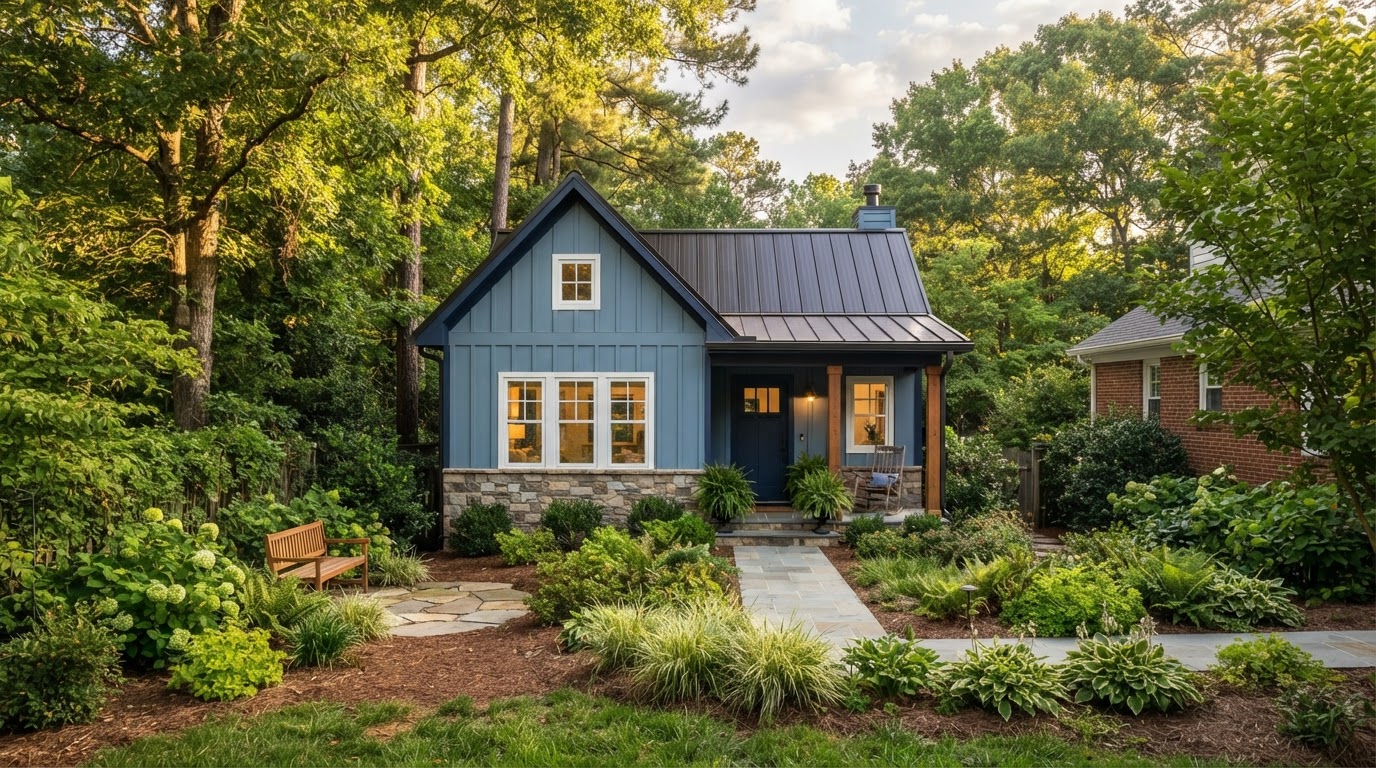
ADU & In-Law Suite Builders Willow Spring NC
Willow Spring homeowners add independent living space through detached ADUs, garage apartments, garage conversions and in-law suites. Because Willow Spring is largely a postal and community designation rather than a single incorporated town — and because parcels can fall under Wake County or Johnston County jurisdiction depending on the actual property — every project starts with a parcel-specific review against the correct governing authority.
Detached ADUs, garage apartments, garage conversions and in-law suites for Willow Spring homeowners, with Wake or Johnston County jurisdiction review and feasibility planning.
Last reviewed: 2026-11-21
ADU & In-Law Suite Options for Willow Spring Properties
Willow Spring homeowners build accessory living space for aging parents, adult children, guests and long-term household flexibility. The project types that fit Willow Spring properties range from detached backyard ADUs and guest cottages to garage apartments, garage conversions and in-law suites — each shaped by the lot, existing structures and the current rules of whichever authority actually governs the parcel.
Willow Spring is not a single incorporated municipality with one zoning code. It functions largely as a postal and community designation spanning parts of Wake County and Johnston County, and some Willow Spring addresses may also fall near Fuquay-Varina or Garner jurisdiction. The authority that sets ADU, accessory structure and utility rules for a given parcel depends on its actual location and zoning designation — not on the mailing address alone. Confirming the actual governing authority through official property records is part of any real feasibility review, and we don't apply Raleigh city standards or a generic 'Willow Spring' rule set to every parcel.
Local ADU Planning Note
ADU and in-law suite feasibility depends on the property's actual jurisdiction, zoning, lot configuration, utilities, existing structures and proposed use. Willow Spring is not a single regulatory authority — confirm whether your parcel is governed by Wake County, Johnston County or an adjacent municipality before final design.
Detached ADUs for Willow Spring's Varied Lots
Willow Spring's mix of newer subdivisions and less-dense residential properties means some parcels have genuine room for a freestanding backyard ADU. A detached ADU is the most independent living option and is often chosen for parent ADUs, guest cottages and downsizing.
We don't imply every Willow Spring property is large. Lot sizes vary widely across the area, and the buildable area is what's left after setbacks, easements, existing improvements and lot-coverage limits are accounted for under the correct jurisdiction. One-bedroom and two-bedroom detached ADUs each carry different utility and septic implications. On properties outside municipal utility service, detached ADUs may involve well water, septic and longer utility runs — which makes utility and septic feasibility a defining early question.
Adult-child ADUs and parent ADUs are common goals where room allows. Where a detached ADU doesn't fit the lot, garage and outbuilding conversions or internal home conversions often become the more realistic path.
Garage Apartments & Garage Conversions in Willow Spring
Garage-based projects are a practical entry point on many Willow Spring properties, where garage-oriented homes and detached garages appear across housing eras. A garage conversion reuses existing enclosed footprint; a garage apartment adds independent living space above or beside a garage; a detached garage conversion reuses an existing outbuilding's footprint.
The existing structure is always the deciding factor. A detached garage conversion reuses footprint but adds utility-routing distance. An apartment above an existing garage depends on whether the foundation and framing can carry a second story — frequently they can't, and a new garage built with an apartment becomes the realistic path. We evaluate the slab, foundation, framing, roof structure and moisture history before recommending conversion.
A garage in-law suite can work when the garage is well-located relative to the main home and structurally sound. On Willow Spring's varied lots, garage projects can preserve yard space that a separate detached ADU would consume — but only if the existing structure can support residential conversion.
Willow Spring Property & Housing Context
Willow Spring's residential character blends newer subdivisions and less-dense residential properties, with larger lots in some areas and outbuildings on many parcels. That range is materially different from denser Wake County suburbs and directly shapes which ADU project types are realistic on a given parcel.
Newer subdivisions may carry HOA covenants that restrict accessory structures independently of county zoning. Less-dense properties and larger lots may have garage-oriented homes, existing accessory structures, and well or septic service rather than municipal utilities. Because Willow Spring spans two counties, two parcels with the same mailing address can face different zoning authorities, utility providers and septic rules — which is why jurisdiction confirmation comes before any design recommendation.
We don't generalize about which Willow Spring neighborhoods allow ADUs or which county governs a given mailing address. We verify the actual property record, zoning designation, utility jurisdiction and any private covenants for the specific parcel before recommending a project type.
Private covenants are separate from zoning
County zoning approval does not override HOA or private covenant restrictions. Confirm both county and private requirements before final design, especially in newer covenant-governed communities.
Willow Spring Jurisdiction & ADU Rules
The rules that apply to a Willow Spring property depend on the parcel's actual jurisdiction. Willow Spring is not a single incorporated town with one zoning code, so we don't write 'Willow Spring allows…' as if one authority governs every address. Instead we confirm whether the parcel is under Wake County jurisdiction, Johnston County jurisdiction, or an adjacent municipality — then apply the current rules for that authority.
We don't apply Raleigh city standards or a generic 'Willow Spring' rule set to every parcel. Wake County and Johnston County may define accessory dwellings differently, permit them in different districts, and set different dimensional standards. Where a Willow Spring mailing address falls under an adjacent municipality, that town's rules apply instead. We don't invent county or municipal requirements. Where a specific rule can't be verified at review time, we say plainly that it requires property-specific confirmation.
| Topic | What to Verify for Willow Spring |
|---|---|
| Jurisdiction | Wake County vs Johnston County (or adjacent municipality) for the specific parcel |
| ADU classification | How the governing authority defines an ADU or accessory apartment |
| Permitted districts | Which zoning districts allow accessory dwellings under that authority |
| Setbacks | Current setback standards for the governing authority |
| Height & size | Any limits on ADU height, footprint or floor area |
| Utilities | Public water/sewer vs well/septic for the specific parcel |
| County boundary | Whether the parcel is in Wake County or Johnston County |
| Permit process | Current review workflow for the governing authority |
Want to know if your property qualifies?
Start with a parcel-specific feasibility review of your Raleigh or Triangle address.
In-Law Suites & Aging-Parent Housing in Willow Spring
Willow Spring families building for aging parents or multigenerational living often choose an in-law suite. The term describes the household use, not a single project type — the same goal can be met by an attached in-law addition, a first-floor suite, a detached parent ADU, an accessible ADU or a garage in-law suite.
For aging parents, design usually centers on proximity and accessibility. An attached first-floor suite with a private entrance keeps parents close and simplifies caregiver support. On larger Willow Spring parcels, a detached parent ADU can offer genuine independence — but it adds outdoor exposure and depends on utility and septic feasibility. A garage in-law suite can work when the garage is well-located and structurally sound. On septic properties, bedroom count can affect septic capacity and should be verified early.
We plan accessibility around the household — wider doorways, accessible bathrooms, level entries and future caregiver access — without claiming ADA compliance unless a project is specifically designed and verified to that standard.
Utilities, Septic & Site Feasibility
Utility and septic review is often decisive on Willow Spring properties, where the mix of subdivision lots and less-dense parcels means utility service varies parcel-to-parcel. Whether a parcel is on public water and sewer or on well and septic can determine whether an ADU is feasible at all.
Properties outside municipal utility service areas may require additional septic or well-related review. Septic capacity — and whether the existing system can support an additional dwelling or bedroom — can be a decisive feasibility factor and may require separate Wake or Johnston County environmental health review. We don't invent county septic requirements; we confirm what applies to the specific parcel. Electrical service may need a panel upgrade, and long utility runs on larger parcels add trenching scope. Driveway and site access matter for construction staging.
- Public water/sewer vs well/septic for the specific parcel
- Septic capacity for an additional dwelling or bedroom
- Electrical panel capacity and potential service upgrade
- Long utility runs and trenching scope on larger parcels
- Existing garage or outbuilding condition for conversions
- Driveway and construction access for staging
Verify Jurisdiction Before Design
The right ADU type on a Willow Spring property depends on the lot, existing structures, household goals, utilities, septic and budget — and on which authority actually governs the parcel. A feasibility review confirms jurisdiction first, then narrows the options to what actually fits your parcel under current Wake County, Johnston County or adjacent-municipality rules.
We serve Willow Spring homeowners from our Raleigh-based practice. There is no separate Willow Spring office, and we don't claim one. Every Willow Spring project is reviewed against the correct governing authority for the specific parcel, with jurisdiction confirmed through official property records.
Nearby areas we also serve: Fuquay-Varina, Angier, Garner and Clayton. Each county and municipality sets its own rules, so a Willow Spring project isn't automatically the same as one across the county line.
Common Questions About ADU & In-Law Suite Construction in Willow Spring NC
Whether an ADU is allowed on a Willow Spring property depends on which authority actually governs the parcel — Wake County, Johnston County or an adjacent municipality — plus the zoning district, lot, setbacks, utilities, septic and any HOA covenants. Willow Spring is largely a postal designation rather than a single incorporated town, so there is no one 'Willow Spring' rule set. A parcel-specific feasibility review confirms what's permitted.
It depends on the actual parcel. Willow Spring spans parts of Wake County and Johnston County, and some addresses may fall near an adjacent municipality. Zoning authority is confirmed through official property records, not the mailing address. We confirm the governing authority before applying any rules.
A garage apartment in Willow Spring is possible when the existing garage can structurally support a second story, or when a new garage is built with an apartment from the start. Whether an existing garage can carry living quarters above requires structural evaluation, and the project still has to meet the governing authority's accessory structure rules. A structural evaluation should come before design.
Larger Willow Spring parcels can be good candidates for a detached ADU where setbacks and lot coverage allow, but feasibility still depends on utility routing, well or public water, septic capacity, access and the current rules of the governing authority. A feasibility review confirms what fits your specific parcel.
ADU feasibility on a septic property in Willow Spring depends on whether the existing septic system has capacity for an additional dwelling or bedroom. Septic capacity may require separate Wake or Johnston County environmental health review and can be a decisive factor. We don't invent septic requirements — we confirm what applies to the specific parcel.
Willow Spring spans both. It is largely a postal and community designation rather than a single incorporated town, and parcels can fall under Wake County or Johnston County jurisdiction depending on the actual property location. Some addresses may also fall near an adjacent municipality. Jurisdiction is confirmed through official property records.
Yes. Willow Spring properties in newer HOA-governed communities may have covenants that restrict accessory structures, exterior changes or rental use separately from county zoning. County approval and private covenant approval are separate — confirm both.
An in-law suite in Willow Spring can take several forms — an attached addition, first-floor suite, garage in-law suite or detached parent ADU — depending on the lot, existing structures, accessibility needs and the rules of the governing authority. A feasibility review identifies which project type fits your property and household goals.
No. We serve Willow Spring homeowners from our Raleigh-based practice and don't maintain a separate Willow Spring office or local address. Willow Spring projects are reviewed against the correct governing authority for the specific parcel.
Continue exploring Willow Spring NC
Discuss Your Willow Spring Property
Share your Willow Spring lot and household goals. We confirm the actual governing jurisdiction for your parcel, then review zoning, setbacks, utilities, septic and existing structures to find the project type that fits.