
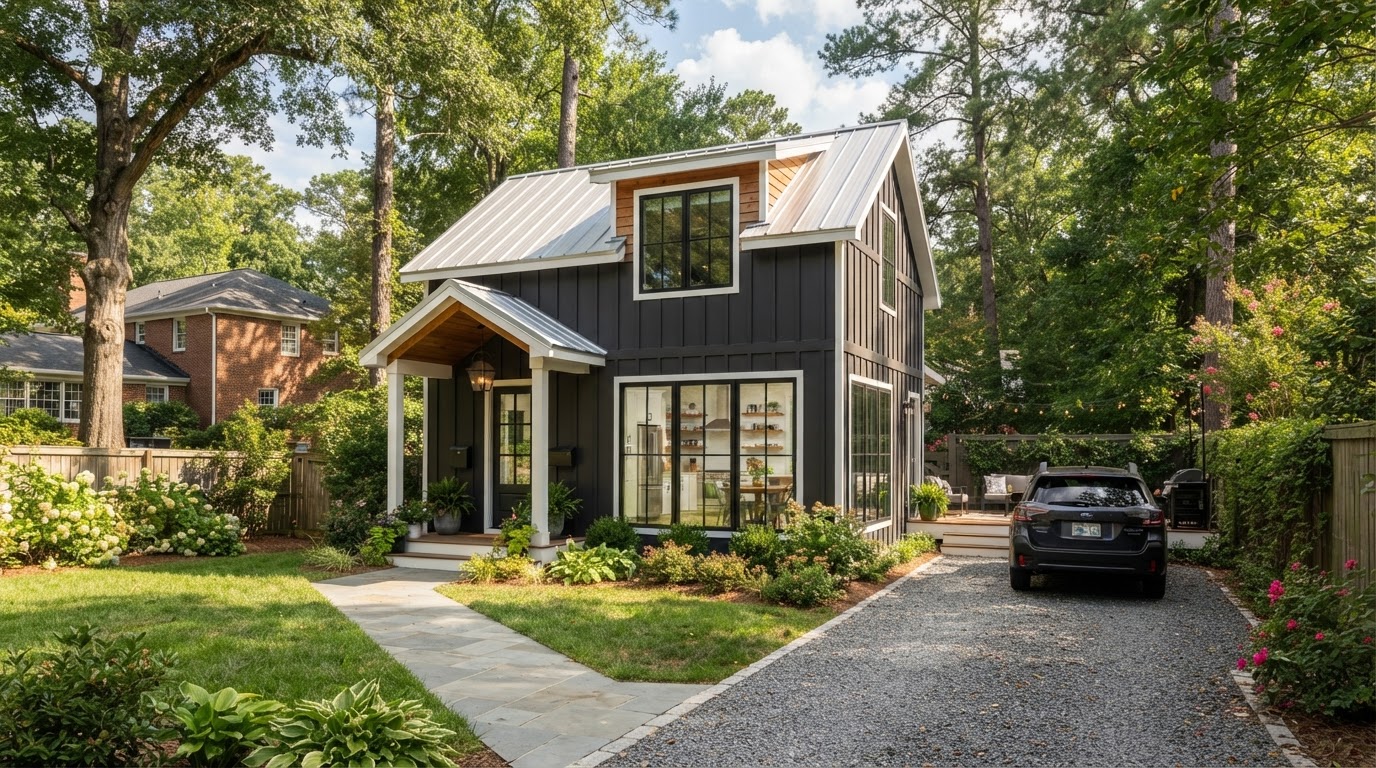
ADUs for Rental Income Raleigh NC
An ADU can be potential income-producing space where legally permitted. A detached backyard ADU, a garage apartment or a basement apartment can serve as a long-term rental, giving the homeowner a second income source on their own property. But rental use depends on the jurisdiction, the current rules, the property and any private restrictions — so the design and the rental rules are verified before the project is built, not after.
ADUs for rental income in Raleigh — building accessory dwelling units as potential income-producing space where legally permitted, with tenant privacy, long-term flexibility and property-specific rental rule verification before building.
Can a Raleigh ADU Be Used as a Rental?
Whether an ADU can be rented depends on the property's jurisdiction, the current rules, the ADU configuration and any applicable private restrictions. Some jurisdictions allow long-term ADU rentals; others have owner-occupancy requirements, rental-type restrictions or other limitations. The answer is property-specific, and it should be verified before the project is built.
We do not guarantee that an ADU can be legally rented. Rental permissions and restrictions can depend on current law, zoning, property conditions, HOA or private covenants and the rental type. The design plans the ADU as a complete residence; the rental rules are verified for the specific property as part of the feasibility and planning.
Verify rental rules before building
Rental use should be verified for the specific property before the project is built. Building an ADU on the assumption that it can be rented, without confirming the rules, is a risk. The feasibility and planning process identifies what applies to the property.
ADU Types Homeowners May Consider for Rental Use
Several ADU types can serve as rental space where permitted, each with different implications for tenant privacy, cost and property impact. The right type depends on the property, the budget and the rental goals.
Detached ADU
A freestanding backyard residence — maximum tenant privacy, a true separate dwelling.
Garage apartment
A residence above or beside a garage — compact, separate entrance, often a good rental fit.
Garage conversion
A converted garage into a residential unit — single-level, ground access.
Basement apartment
A lower-level apartment — works where access, light and ceiling conditions support comfortable living.
Attached ADU
New square footage connected to the home — can include a private entrance for the tenant.
Designing for Tenant Privacy
A rental ADU is designed for tenant privacy. The tenant needs their own entrance, their own kitchen, their own bathroom, their own laundry and their own outdoor space — the components of a residence, not a shared room. The design plans these so the tenant has a real, private living space and the homeowner's household is not disrupted.
- Private entrance — the tenant's own arrival and independence
- Kitchen — a functional kitchen for the tenant's own meals
- Bathroom — a private bath for the tenant's use
- Laundry — in-unit laundry so the tenant does not depend on the main home
- Parking and access — where the tenant parks and how they access the unit
- Outdoor space — a patio or area that is the tenant's own
- Sound and privacy — separation from the main household
Want to know if your property qualifies?
Start with a parcel-specific feasibility review of your Raleigh or Triangle address.
Design for Long-Term Flexibility
A rental ADU is a long-term asset, and the design should account for how the space may be used over time. A well-designed ADU can serve a tenant today and a parent, an adult child, a caregiver or a guest later. Planning for that flexibility from the start keeps the space useful for the household across decades, not just during one rental period.
This is why the ADU is designed as a complete residence rather than a minimal rental unit. A complete residence can serve any future occupant; a minimal unit can only serve a tenant. The flexibility is built into the layout.
Cost and Feasibility Come Before Income Projections
Before any income projection, the project has to be feasible and the cost has to be understood. Site work, utilities, foundation, structure, design and permits all contribute to the project scope, and the scope determines the cost. The cost and the feasibility are established first; the income potential is evaluated against the actual project, not against an assumption.
We do not publish unverified ROI claims, income projections or payback periods. The financial evaluation is property-specific, based on the actual project cost and the actual rental conditions that apply to the property. The design and the feasibility come first; the income question follows.
Verifying Rental Rules Before Building
Rental rules are verified before the project is built. The verification looks at the municipal rules that apply to the property, the rental type (long-term, short-term or other), any HOA or private covenants that restrict rental use, and the property-specific requirements. The design and the rental rules are confirmed together so the project is built to match what the property actually allows.
- Municipal rules — what the jurisdiction allows for ADU rentals
- Rental type — long-term, short-term or other restrictions
- HOA or private covenants — any private restrictions on rental use
- Property-specific requirements — conditions that apply to the specific property
Common Questions About ADUs for Rental Income
It depends on the property's jurisdiction, the current rules, the ADU configuration and any applicable private restrictions. Some areas allow long-term ADU rentals; others have owner-occupancy requirements or rental-type restrictions. Rental use should be verified for the specific property before the project is built. We do not guarantee that an ADU can be legally rented.
Short-term rental rules are jurisdiction-specific and can be more restrictive than long-term rental rules. Whether a short-term rental is allowed depends on the property, the jurisdiction and any private restrictions. The rental type should be verified for the specific property before building.
We do not make income, ROI or payback claims. Whether an ADU's rental income offsets its cost depends on the actual project cost, the actual rental conditions and the rules that apply to the property. The financial evaluation is property-specific. The cost and feasibility are established first; the income question follows.
Detached ADUs and garage apartments often work well for rentals because they offer tenant privacy and a separate entrance. Basement apartments and attached ADUs can also work where the conditions support comfortable living. The right type depends on the property, the budget and the rental goals.
Yes. A well-designed rental ADU can later serve a parent, an adult child, a caregiver or a guest. Designing the space as a complete residence rather than a minimal rental unit keeps it flexible for future household uses. The future use depends on the rules in effect at that time.
Verify the municipal rules for ADU rentals, the rental type allowed (long-term, short-term or other), any HOA or private covenants that restrict rental use, and the property-specific requirements. Building on the assumption that an ADU can be rented, without confirming the rules, is a risk. The feasibility and planning process identifies what applies to the property.
Continue exploring ADUs for Rental Income
Exploring a Rental ADU?
Tell us about your property and your goals. We help you understand the design considerations for a rental ADU and plan the project — with the rental rules verified for your specific property before you build.