
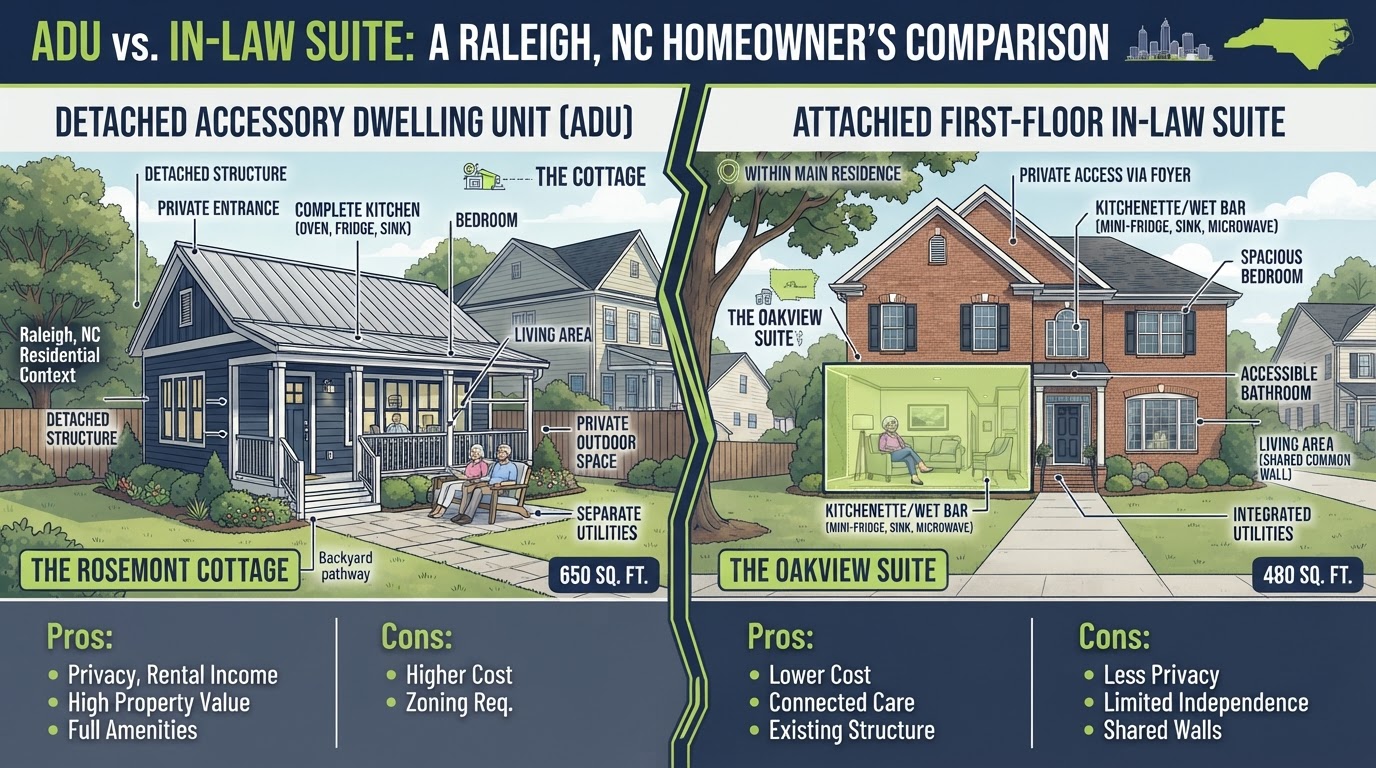
ADU vs In-Law Suite: What's the Difference?
An ADU is generally a distinct accessory dwelling concept defined by applicable local regulations, while 'in-law suite' is a homeowner term that can describe many types of family living space. An in-law suite may or may not qualify as an ADU depending on its design, facilities and local rules. The distinction matters for permitting, rental use and how the space is legally classified — so it's worth understanding before you build.
Guide to the difference between an ADU and an in-law suite in Raleigh: regulatory classification, kitchen and bathroom, independent entrance, aging parents, rental use and permit considerations.
Last reviewed: 2026-11-21
ADU vs In-Law Suite at a Glance
The difference is simpler than it seems: 'ADU' is a regulatory category, while 'in-law suite' describes how a family uses a space. An in-law suite can be an ADU — but not every in-law suite is one, and not every ADU is used as an in-law suite.
| Factor | ADU | In-Law Suite |
|---|---|---|
| Regulatory classification | Defined by local rules | Homeowner term, not a legal category |
| Kitchen | Often included for independence | Optional — varies by household |
| Bathroom | Typically included | Typically included |
| Independent entrance | Often required or expected | Desirable but not always required |
| Location | Detached, attached, internal or garage-based | Anywhere in or near the home |
| Primary use | Independent dwelling | Family living space |
| Privacy | Usually high | Varies by configuration |
The table frames the tendencies, but the real distinction is regulatory. What makes a space an ADU is whether it meets the local definition of an accessory dwelling unit — and that definition is set by the governing jurisdiction, not by what the family calls it.
What Is an ADU?
An ADU — accessory dwelling unit — is a regulatory concept for a secondary, independent dwelling on a lot that already has a primary home.
Under Raleigh's current rules, an ADU is generally a separate living unit with its own kitchen, bathroom and sleeping facilities. ADUs can take several forms: detached (a backyard cottage), attached (an addition connected to the home), internal (a converted portion of the existing home) or garage-based (a conversion or apartment above a garage). The exact definition and what qualifies should be confirmed against current Raleigh requirements, but the core idea is a self-contained dwelling subordinate to the main house.
What Is an In-Law Suite?
'In-law suite' is a homeowner term for living space designed for a family member — typically an aging parent, but also an adult child or relative. It describes use, not a legal category.
- Bedroom and bath suite — a private room with a dedicated bathroom
- First-floor suite — accessible living space on the main level
- Addition — new square footage built for family
- Garage suite — a garage conversion used as living space
- Basement suite — a lower-level living area
- Detached parent suite — a backyard cottage used by family
Because 'in-law suite' isn't a regulatory term, the same physical space might be called an in-law suite by the family and an ADU by the city — or it might not meet the ADU definition at all. A bedroom with a bathroom but no kitchen and no separate entrance is an in-law suite in family terms, but it likely isn't an ADU. The facilities and configuration determine the classification.
Does an In-Law Suite Need a Kitchen?
The kitchen is often the dividing line between an in-law suite and an ADU — but the answer depends on the desired level of independence and the current rules.
An in-law suite used for a parent who shares meals with the main household may not need a kitchen — a bedroom, bathroom and sitting area may suffice. But if the goal is genuine independent living, a kitchen or kitchenette becomes important, and including one may push the project toward ADU classification. There is no invented regulatory threshold here — whether a kitchen triggers a particular classification depends on current Raleigh rules, which should be confirmed for the specific design.
The practical question is what level of independence the household needs. A kitchenette may provide enough for a parent who mostly joins the main household for meals. A full kitchen supports a more autonomous lifestyle — and may be what makes the space function as an ADU rather than a bedroom suite.
Which Is Better for Aging Parents?
For aging parents, the better choice depends on proximity, independence, accessibility and the caregiving relationship — not the label.
| Factor | In-Law Suite | ADU |
|---|---|---|
| Privacy | Varies by configuration | Usually high |
| Independence | Moderate — may share main home | High — self-contained |
| Proximity for caregiving | Very close | Close but separate |
| Accessibility | First-floor suite often ideal | Depends on design and access |
| Cost / scope | Can be less if reusing space | Often more — full dwelling |
A first-floor in-law suite inside the home often makes sense for a parent who needs proximity and shared household support. A detached ADU may suit a parent who values independence and their own entrance. Neither is universally better — the right choice follows the parent's mobility, the caregiving plan and the property.
Want to know if your property qualifies?
Start with a parcel-specific feasibility review of your Raleigh or Triangle address.
Which Is Better for Rental Use?
If rental use is a goal, a legally recognized independent dwelling is usually what matters — and that tends to favor ADU classification.
A space that meets the local ADU definition — with a kitchen, bathroom, private entrance and independent living facilities — is more likely to be rentable as a dwelling than a bedroom suite that shares the main home's kitchen. But rental legality must be verified separately: current Raleigh rules, HOA restrictions and the property's circumstances all affect whether an ADU can be rented, and for how long. We don't promise that any ADU can be rented — that's a property-specific question.
Permits and Regulatory Differences
Because an ADU is a regulatory category and an in-law suite is not, the permit path depends on what you're actually building — not what you call it.
A project that creates an independent dwelling with a kitchen, bathroom and private entrance will generally follow the ADU permit path — zoning review, building code, life-safety and utility coordination. A project that adds a bedroom and bathroom without a kitchen or separate entrance may follow a different path — still permitted, but potentially with different requirements. The classification is determined by the design and the facilities, confirmed against current rules.
Choose Based on the Household, Not the Label
The useful question isn't 'ADU or in-law suite?' — it's 'what does this household need, and what design delivers it?'
An in-law suite can be an ADU. An ADU can be used as an in-law suite. The terms describe different things — one is legal, one is familial — and they overlap. Start with who will live there, what independence they need, what the property supports and what the current rules allow. Then the right project type becomes clear.
Common Questions About Raleigh ADU vs In-Law Suite Guide
Not necessarily. An ADU is a regulatory category for an independent accessory dwelling. 'In-law suite' is a homeowner term for family living space. An in-law suite can be an ADU if it meets the local definition — but a bedroom and bath without a kitchen or separate entrance probably isn't one.
Yes. Adding a kitchen or kitchenette may increase independence and can push the project toward ADU classification, depending on current rules. Whether a kitchen triggers a particular classification should be confirmed against current Raleigh requirements for the specific design.
Yes. An ADU is a legal category; an in-law suite is a use. A detached or attached ADU can absolutely be used as living space for an aging parent or adult child. The terms overlap — one is regulatory, one is familial.
It depends. A first-floor in-law suite inside the home often suits a parent who needs proximity and shared support. A detached ADU may suit a parent who values independence and their own entrance. The right choice follows the parent's mobility, the caregiving plan and the property.
A space that meets the local ADU definition is more likely to be rentable as an independent dwelling. But rental legality depends on current Raleigh rules, HOA restrictions and the property's circumstances. Rental use must be verified separately — we don't promise that any project can be rented.
Yes — any project creating new living space, adding a bathroom, or altering electrical, plumbing or structure requires permitting. The specific path depends on what's being built and whether it qualifies as an ADU, which should be confirmed against current rules.
A separate entrance is desirable for privacy and is often expected for an ADU. For a bedroom suite without independent facilities, it may not be required. The need depends on the project's classification and the household's goals.
Start with who will live there and what independence they need, then confirm what the current Raleigh rules require for ADU classification. A project with a kitchen, bathroom, private entrance and independent living facilities is more likely to be an ADU. A feasibility review can clarify this for the specific property.
Continue exploring ADU vs In-Law Suite
Not Sure Which You're Building?
Tell us about the household and the space you're considering. We help you understand whether the project is an ADU, an in-law suite, or both — and what that means for permitting and use.