
ADU Utility Connection Costs Raleigh NC
ADU utility connection costs depend on distance, existing service, site conditions, capacity and whether the project is detached or attached. There is no single reliable utility number for every Raleigh property — the infrastructure work is driven by conditions specific to the lot. This page explains the cost drivers so you can plan realistically without relying on a fabricated universal figure.
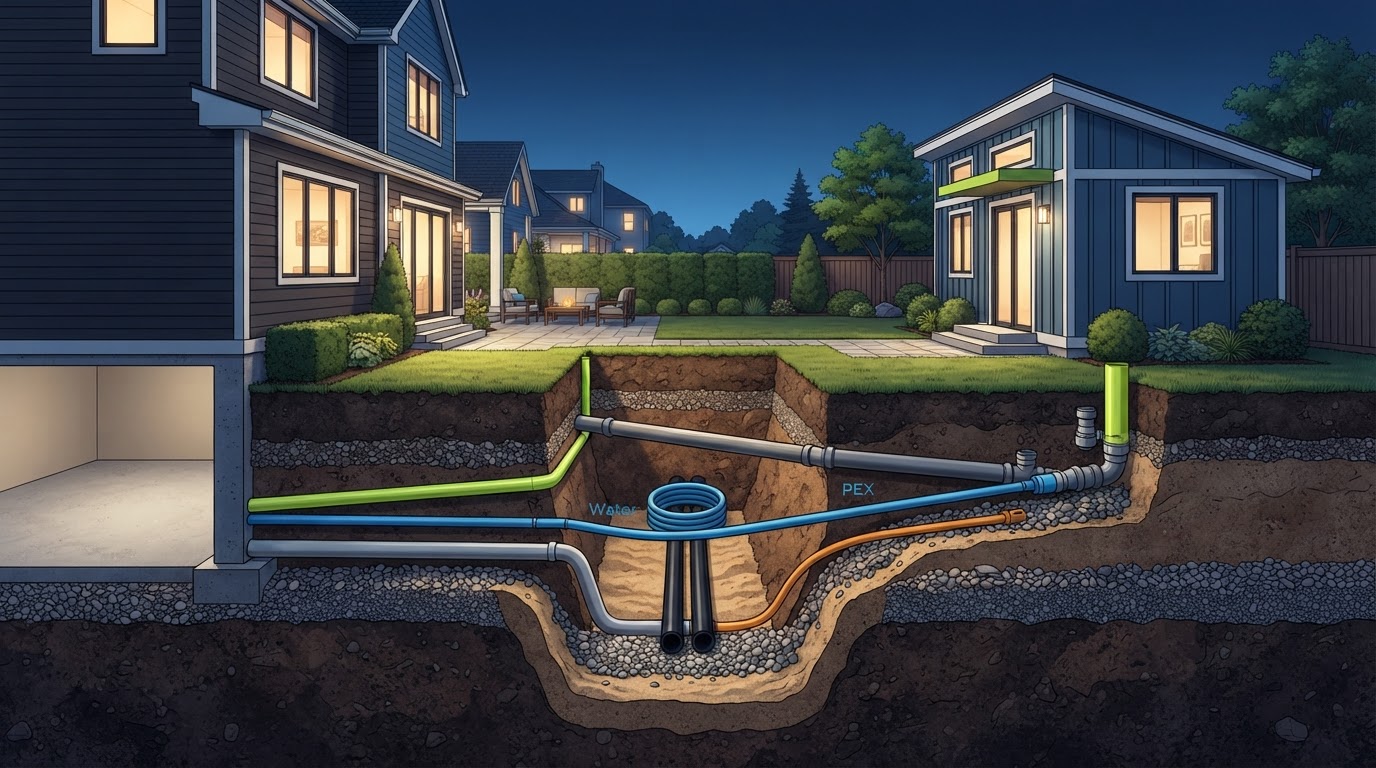
Cost drivers for ADU utility connections in Raleigh: water, sewer, septic, electrical service, trenching and site conditions, and why utility costs are property-specific.
Last reviewed: 2026-11-21
How Much Do ADU Utility Connections Cost?
There is no single reliable ADU utility-connection cost for Raleigh. The total depends on water, sewer or septic, electrical service, trenching distance, site conditions and whether the ADU is detached or attached — and each of those varies by property.
A detached ADU at the back of a deep lot with a long trench run to existing services costs more to connect than an attached addition tapping into systems right at the house. A property on septic may face a very different utility picture than one on public sewer. Rather than quote a universal number that would mislead, this page explains what drives utility costs so you can see where the budget goes and why it's property-specific.
A planning estimate, not a quote
Any utility cost figure is a planning estimate, not a project quote. Actual utility costs depend on distance, existing service, capacity, site conditions and current utility-provider requirements. Confirm requirements for the specific property before final design.
Water Connection Cost Drivers
Water connection cost is driven by how far the ADU sits from existing service, how the service is configured, and what excavation the routing requires.
- Distance from the existing water service to the ADU
- Existing service size and capacity
- Meter or service configuration requirements
- Excavation and trenching through the route
- Routing around trees, hardscape or existing utilities
- Property-specific site conditions
We don't invent Raleigh meter fees. Water service requirements — whether a shared service, an upgraded service or a separate meter applies — should be verified with the utility provider for the specific property. The cost follows the configuration the project actually requires, not a generic assumption.
Sewer Connection Cost Drivers
Sewer connection cost depends on the existing sewer routing, distance, elevation and what excavation the connection requires. Sewer is gravity-sensitive in a way water is not, which adds complexity.
- Existing sewer lateral and connection point
- Distance from the ADU to the connection
- Elevation and slope — sewer relies on gravity flow
- Excavation depth and site conflicts
- Routing around existing utilities and hardscape
Because sewer flow depends on elevation, a long or deep run can require more excavation than a water line of the same length. We don't provide sewer-tapping instructions or invent connection fees — those are utility- and property-specific. The cost driver to understand is that distance and elevation, not just length, shape the sewer scope.
Septic Properties
Properties not served by public sewer may require septic evaluation and approval, and septic capacity can dramatically affect ADU feasibility and cost.
A septic system is sized to the number of bedrooms it serves. Adding an ADU may require evaluating whether the existing system has capacity, whether the system needs expansion, or whether a separate system is needed. Septic evaluation and approval involve county or state review depending on the property. We don't fabricate Wake County septic pricing or capacity requirements — those must be verified for the specific property. What's consistent is that septic can be a major feasibility and cost factor, sometimes more significant than the construction itself.
Electrical Connection Cost Drivers
Electrical connection cost depends on existing panel and service capacity, the distance to a detached ADU, and what the new dwelling's loads require.
- Existing panel and service capacity
- Distance from the panel to a detached ADU
- Trenching for underground routing
- New loads — HVAC, kitchen, laundry, water heating, lighting
- Whether a panel or service upgrade is needed
A detached ADU often requires a trench run for electrical, and if the existing service lacks capacity for the new dwelling's loads, a panel or service upgrade may be needed. We don't invent meter or service-upgrade pricing — those depend on the utility provider and the existing system. The cost driver is the combination of capacity, distance and new loads.
Want to know if your property qualifies?
Start with a parcel-specific feasibility review of your Raleigh or Triangle address.
Trenching and Site Conditions
Trenching is where utility costs accumulate quickly, because it has to get through whatever sits between the existing services and the ADU.
- Driveways and hardscape that must be crossed or restored
- Trees and root zones along the route
- Existing underground utilities to avoid
- Slope and elevation changes
- Total distance
- Tight access for excavation equipment
A short, open run across a flat lawn is straightforward. A long run that crosses a driveway, weaves around mature trees and avoids existing utilities is far more involved. Trenching cost doesn't scale cleanly with distance — it scales with what's in the way. That's why two ADUs of the same size can have very different utility costs on different lots.
Attached vs Detached ADU Utilities
Detached ADUs often involve more site routing because utilities have to travel from the house to a separate structure. Attached and internal projects may integrate more closely with existing systems.
An attached addition can sometimes tap into the home's existing water, sewer and electrical at the point of connection, reducing trenching. A detached ADU almost always requires some trench run. An internal conversion — like a basement or garage ADU — may need system upgrades but little new routing. This is one reason project type affects utility cost so strongly, and why a detached ADU isn't directly comparable to a conversion on utility scope alone.
Verify Utilities Early
Utility strategy belongs in feasibility — before floor plans are finalized. Discovering a utility constraint late can force redesign or blow a budget that was built on assumptions.
A property review that addresses water, sewer or septic, electrical capacity and trenching access gives the design team real constraints to work within. It also gives the homeowner a realistic utility budget early, when there's still flexibility to adjust the ADU's size, placement or scope. Verifying utilities late is one of the most common reasons projects run over budget — and it's avoidable.
Common Questions About Raleigh ADU Utility Connection Costs Guide
There is no single reliable number. Utility costs depend on distance, existing service, capacity, site conditions and whether the ADU is detached or attached. A detached ADU with a long trench run costs more to connect than an attached addition tapping nearby systems.
It depends on the property, existing service and current utility requirements. Sharing a service is sometimes possible; other configurations require separate or upgraded service. Verify the requirement with the utility provider for the specific property.
Not every project requires the same metering arrangement. It depends on electrical service capacity, panel capacity, the ADU configuration and utility-provider requirements. The electrical strategy should be verified for the specific project.
Septic can be a major cost and feasibility factor. A septic system is sized to the bedrooms it serves, so adding an ADU may require evaluating capacity, expansion or a separate system. Septic evaluation and approval involve county or state review depending on the property.
Trenching has to get through whatever sits between existing services and the ADU — driveways, trees, existing utilities, slope and distance. A short open run is straightforward; a long run crossing obstacles is far more involved, which is why two same-size ADUs can have very different utility costs.
Sometimes, sometimes not. Some construction quotes bundle utility connections; others list them separately. Before comparing quotes, confirm whether water, sewer, electrical and trenching are included or excluded.
During feasibility, before floor plans are finalized. Discovering a utility constraint late can force redesign or blow a budget built on assumptions. A property review that addresses utilities gives the design team real constraints early.
Continue exploring ADU Utility Connection Costs
Plan Your ADU Utilities Early
Utility strategy belongs in feasibility, not after design. Tell us about the property and the ADU you're considering, and we'll walk through the utility questions that affect your budget.